Global real estate remains the dominant asset class, valued at approximately $393-448 trillion (Savills, 2026 estimates), about 3.3 times the global equity market capitalization and 2.8 times that of bonds. In this context, institutional capital is structurally shifting toward rental income streams (SFR/BTR). The institutional share of the US Single-Family Rental market remains low (2.0-3.1%…

The voluntary carbon market is on a well-documented trajectory: roughly $2 billion today, heading toward $100 billion by 2030. CSRD reporting, net-zero commitments, and the rise of tokenized credits are pulling institutional money into a market that was, until recently, a boutique affair of project developers and well-meaning corporates.
There is just one problem, and…
SpaceX (SPCX) faces a probable short-term correction of ≥30% (62-78% probability) from current levels (~$141-146), driven by negative convexity, retail unwind, and liquidity spirals, while long-term (3-10 years) appreciation remains significant.
The company is transitioning from a launch and constellation firm to a multi-planetary spatial infrastructure, data, and AI platform with increasing returns and…
The stablecoin market has crossed a symbolic threshold: a market capitalization of over $315 billion. What was, five years ago, a niche tool for crypto traders has become a cash management infrastructure, for funds, fintechs, corporations, and soon, under the effect of the MiCA regulation, for regulated European institutions. Yet the fundamental question remains unchanged:…
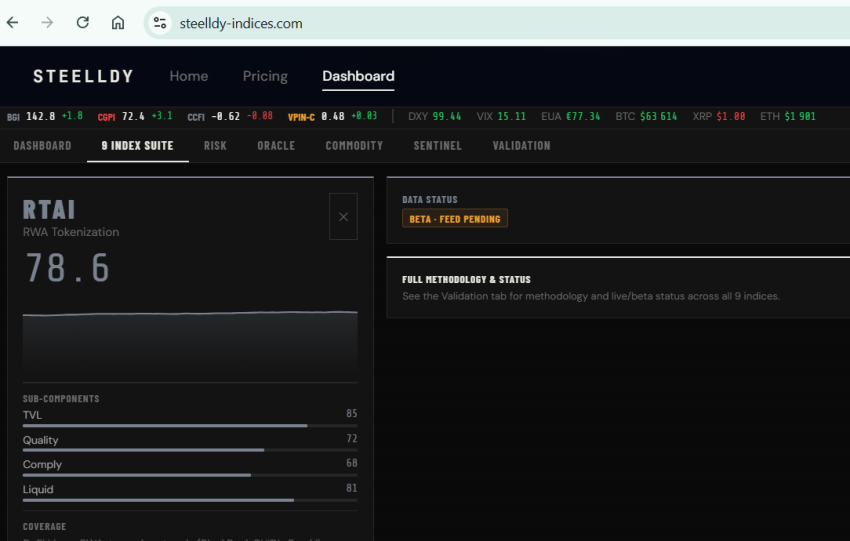
The numbers, first. Tokenized real-world assets crossed $30 billion in early 2026, a 300% year-on-year increase : US Treasury debt ($10.7bn), commodities ($5.1bn), private credit ($2.9bn), institutional alternative funds ($2.2bn) leading the mix. Measured against what is coming, $30bn is a rounding error. The 2030 forecasts, by institution:
Source2030+ forecastScope noteMcKinsey~$2tnExcludes crypto, stablecoins, deposits,…
Tokenized Municipal Micro-Bonds. We use the XRPL infrastructure to issue tokenized bonds funded by urban tolls… and local property taxes from specific neighborhoods. Steelldy provides the Risk Engine to rate these micro-bonds in real time via local OSINT.
The shift from appreciation tokens to yield structures represents the true institutional inflection point for RWAs. It…
According to the methodology of Dixit and Pindyck (1994), gold contains an implicit call option on the collapse of the fiat system. The price dynamics St incorporate a Poisson jump process Nt: dSt/St = μdt + σdWt + (J-1)dNt, where Nt∼Poisson(λ) for the arrival of a systemic fiat crisis, and J is the jump amplitude…
Gold (Sharpe 0.4-0.7, Volatility 12-15%) acts as a reserve asset, inversely correlated with the DXY. Its low Sharpe ratio is due to no carry yield and custody costs, but it offers absolute decorrelation during systemic geopolitical shocks. Physical gold is now central to monetary influence wars (BIS Basel 2024-2025). Steelldy Engine 3.8 and Planet Labs…
A long-only Bitcoin strategy with a target Sharpe ratio of 0.8–1.2 and 60–70% volatility is an inherently risky proposition. The asset is high-beta with extreme negative skew and fat tails. While the elevated Sharpe suggests a high risk premium, this masks a pathological risk of ruin during retail capitulation events.
The market's inefficiency stems…
Institutional and fundamental legal framework
Unlike many central banks, the Bank of Japan (BOJ) has no autonomous decision-making power over foreign exchange intervention. This authority rests solely with the Minister of Finance under Japan's Foreign Exchange and Foreign Trade Act. The BOJ acts only as a technical agent for the Ministry of Finance (MoF), with…
Carbon Credit Market
Markets