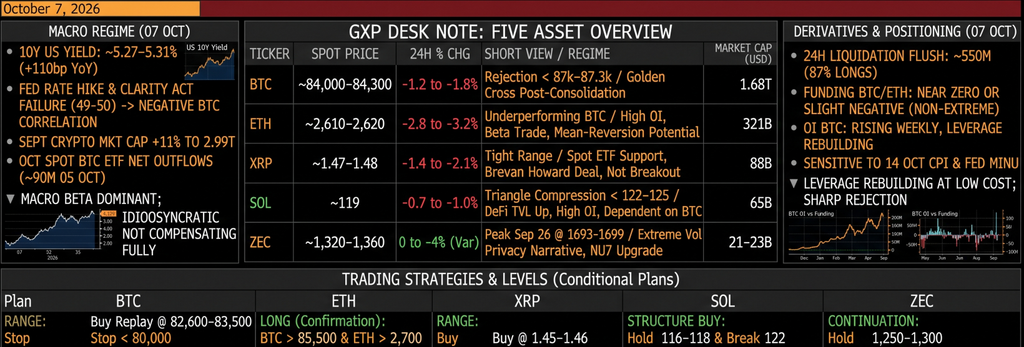
The paradigm has shifted. Digital assets no longer react like call options on technological adoption but rather as long-duration derivatives hyper-sensitive to real interest rates. With the 10-year U.S. Treasury yield fracturing the 5.27% barrier in early October 2026, the negative correlation between crypto Beta and yields dictates the entire market microstructure. This www.steelldy-indices.com note deciphers the current compression dynamics across five major assets (BTC, ETH, XRP, SOL, ZEC), drawing on regime analysis, derivatives positioning, and institutional liquidity (ETFs).
1. Regime Modeling: Absorption and Tail Risk
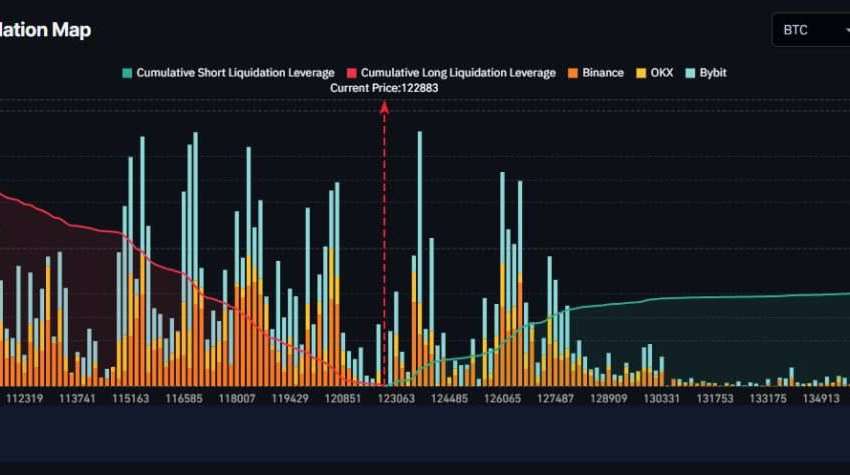
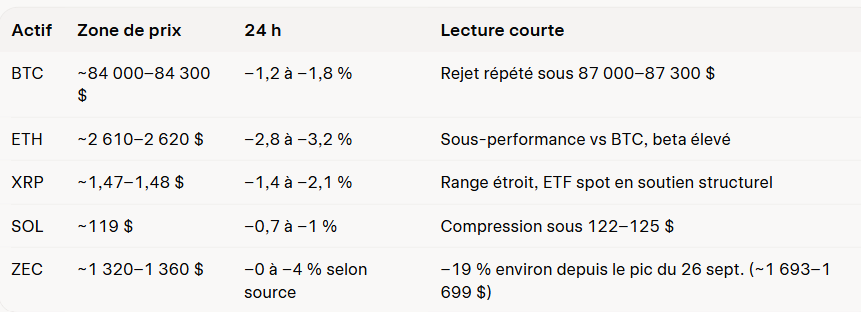
The market is navigating a compressed volatility Markov regime. Total market capitalization touched $2.99T in September, driven by $3.49B in inflows to Spot BTC ETFs, before experiencing a Q4 flow reversal amid the failure of the CLARITY Act and monetary tightening. ¤ Microstructure and Leverage: The recent $550M flush in liquidations (87% long positions) purged speculative leverage. Unlike the 2025 peaks, BTC/ETH perpetual funding rates hover around zero. The market is not structurally long; it is in an absorption phase under resistance. ¤ Tail Asymmetry: The primary risk is not an idiosyncratic shock but a liquidation cascade (stop-run) if sovereign rates trigger a simultaneous breakdown of major support levels.
BITCOIN (BTC). The Dominant Beta
Bitcoin is locked in a post-Golden Cross consolidation (50-day MA crossing the 200-day MA). Five attempts to break the distribution resistance ($87,000–$87,300) have been rejected. Range Strategy: The risk/reward ratio optimizes only in the lower third ($82,600–$83,500), with strict invalidation on a daily close below $80,000 (the 50-day MA level, acting as a psychological and algorithmic break point). Conditional Breakout: Corporate accumulation (Strategy’s 848,000 BTC) is insufficient to absorb institutional selling pressure tied to the opportunity cost of a 5.3% 10-year yield. A breakout buy is justified only on a clean daily close above $87,300.
ETHEREUM (ETH). Underperformance and High Beta
Ether shows structural underperformance against BTC, weighed down by an Open Interest (OI) disproportionate to its market cap (~$321B). Hedging Strategy: ETH’s high leverage component exposes it to severe slippage in the event of a BTC correction. The asset should be underweight. Arbitrage models favor a relative short ETH/BTC pair if it breaks below historical supports. A long bias is justifiable only if BTC reclaims the $8…,500 zone and ETH reclaims $2,..00.
RIPPLE (XRP). Institutional Structural Support
XRP’s dynamics are uncorrelated, supported by continued flows into Spot ETFs (estimated cumulative $1.7B). The Ripple–Brevan Howard infrastructure announcement solidifies the institutional floor. Channel Strategy: The asset is in tight compression. Invalidation is below $1.40. The bias is long within the range, but the structure does not indicate an imminent breakout given regulatory slowness post-CLARITY Act.
SOLANA (SOL): Volatility and DeFi Compression
With Total Value Locked (TVL) expanding toward $6.7B, SOL exhibits intrinsic relative strength but remains constrained under the $125 level. Breakout Strategy: The $122–$125 zone acts as a glass ceiling. Holding the $… support is critical. A confirmed breakdown below $114 would invalidate the bullish structure. Conversely, a break above $… would trigger algorithmic buy orders with a target at $150. High OI makes the asset hyper-sensitive to stop-runs in both directions.
ZCASH (ZEC): The Stochastic Anomaly
ZEC is the outlier of this cycle (+600% since February), driven by the privacy narrative (Privacy Coins), the NU7 upgrade, and ETF filings (Grayscale ZCSH). The asset just underwent a near-20% stochastic retracement from its late September peak (~$1,695). Volatility-Capped Satellite Strategy: With daily standard deviation near 7%, position sizing management is paramount (ZEC notional should not exceed 20–30% of a standard BTC position). The $1,160–$1,230 zone (Fibonacci 0.382 retracement) serves as major support. Losing $1,250 on a close would trigger a deep deleveraging. ….; shorts already capitulated during the August-September parabolic rally.
Conclusion. Yield-Constrained Allocation The optimized allocation model for the current regime (extreme real rates, fragmented liquidity) demands strict asymmetry. Core portfolio: BTC on a range-bound or neutral approach. Underweight: ETH, due to its leverage-induced slippage risk. Directional satellites: XRP and SOL exploited for mean-reversion at their channel bounds. Ultra-volatile satellite: ZEC, managed with a drastically budgeted risk. As long as the 10-year U.S. yield hovers around 5.3%, the crypto market will remain capped by the cost of capital. A broad bullish repricing will require a strong narrative pivot, either through confirmation of post-ETF institutional liquidity or a easing of macroeconomic pressure at the next Fed minutes.