Skip to content Skip to sidebar Skip to footer

Tag: private credit

Interoperable Tokens (XRP/QNT/COTI), RWA Tokenization, and Gold-Backed Stablecoins

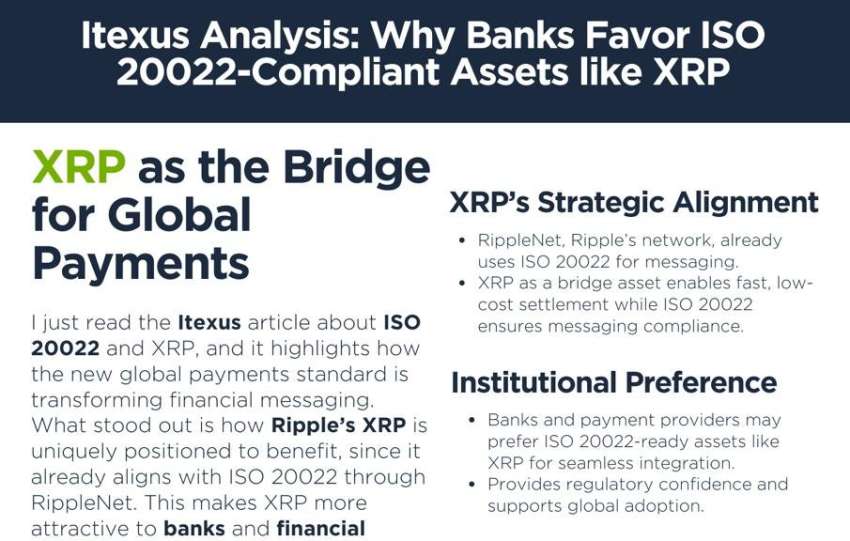
(1) XRP — Settlement Layer and Liquidity Bridge XRP serves as a neutral liquidity bridge between different fiat currencies and tokenized assets. The arrival of seven US spot XRP ETFs (approximately $1 billion in AUM) signals progressive institutionalization. Demand for XRP structurally stems from the volume of transactional flows, which creates continuous buying pressure…

Read more

Hamza Lemssouguer, 35, is shaking up the London finance scene with his big short bets

Hamza Lemssouguer's Arini Capital fund, launched in 2022 with $1.3 billion and reaching $20 billion in assets under management, is highlighted for its focus on European distressed debt and high-yield credit refinancing for companies like Altice. Arini closed its flagship fund at $4 billion to maintain performance and is expanding into CLOs and private credit.…

Read more

Systemic Evaluation of the « Selective Credit Crunch » and Modeling of Bank Non-Contagion

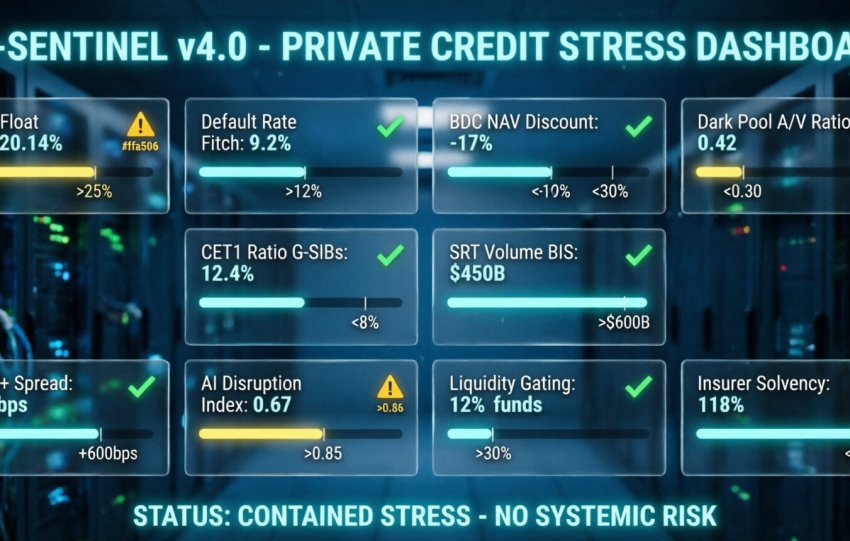
Private Credit will not trigger a systemic global banking crisis like 2008, but acts as an extreme amplifier of sector volatility, generating a "sawtooth recession" in corporate credit with a structural rotation towards AI-Native. The analysis conducted by integrating the 7 quantitative layers (semantic NLP, macro DSGE, factor decomposition, Markov-switching regimes, quantum-classical portfolio optimization,…

Read more

Interopérabilité stablecoins et tokenisation RWA dans les infrastructures monétaires d’une finance parallèle prête à l’échelle mondiale

1. Cadre conceptuel. L’interopérabilité stablecoins-RWA comme condition sine qua non du scaling de la finance parallèle L’interopérabilité entre stablecoins (USDT/USDC dominance >85 % du marché, MC ~300 Md$ au 27/03/2026) et RWA tokenisés (TVL distribuée ~26,63 Md$ ex-stablecoins, rwa.xyz) constitue le pont programmable entre liquidité fiat-native et actifs réels fractionnables. Elle transforme les stablecoins…

Read more

Private Credit Risk Assessment and Liquidity Contagion Dynamics

Morgan Stanley (MS) is experiencing a severe liquidity crisis in its Direct Lending segment. This pressure stems from three systemic factors: (i) massive redemptions by Business Development Companies (BDCs), (ii) rapid devaluation of underlying tech assets (notably due to AI disruption), and (iii) margin compression from falling benchmark rates. We anticipate a “Capital Exodus” similar…

Read more

Study of Gold Dynamics under Kinetic Conflict Regime and Carry Trade Unwinding. Diagnosis as of March 6, 2026

DATE: March 6, 2026 | STATUS: CRITICAL / ABSOLUTE PRIORITY MODEL: Bayesian Inference & Mosaic Theory The singularity of the "Triple Break" Integrated analysis via Steelldy Risk Engine v.12.4 and Steelldy Gotham identifies that we are not in a conventional war cycle for gold. We are witnessing a rare convergence between: (i)…

Read more

Analyse de sensibilité des ratios de couverture des intérêts : Private Credit (PC) vs. High Yield (HY)

SCÉNARIO : PERSISTANCE DES TAUX ÉLEVÉS ("HIGHER FOR LONGER") ET RÉCESSION MODÉRÉE (-15% EBITDA) L'analyse comparative des métriques de risque entre le Private Credit (PC) du Mid-Market et le High Yield (HY) public (BB/B), en février 2026 sous un scénario de taux élevés persistants et de récession modérée (-15% EBITDA), révèle une divergence structurelle…

Read more

The Illusion of Liquidity in « Continuation Deals » and the Dynamics of Refinanced Liabilities. Why Private Credit Firms Are Selling $15bn in Debt to Themselves

The explosion of "Continuation Deals" (rising from $4 billion to $15 billion between 2024 and 2025) signals a break in Private Credit, not healthy innovation. These "self-dealing" transactions transfer credit and duration risk from mature funds to new investors without creating real economic value, masking the deterioration of the underlying assets. As seen by our…

Read more

Evaluation des risques systémiques dans l’éconsystème IA

1. ANALYSE COMPARATIVE : SPV CONTEMPORAINS VS ENTITÉS ENRON Notre analyse compare les entités à vocation spéciale (SPV) d'Enron aux mécanismes financiers contemporains dans l'écosystème de l'IA, soulignant des similarités structurelles et des différences critiques. Concernant les mécanismes fondamentaux, Enron utilisait des SPV avec des ratios de levier extrêmes (3% fonds propres / 97%…

Read more

Analyse stratégique et risque du Private Credit 2025-2035

1. CONTEXTE MACRO-STRATÉGIQUE : UN BASCULEMENT STRUCTUREL, PAS UNE MODE Le private credit n’est plus un "segment alternatif". C’est un phénomène de remplacement systémique du financement bancaire traditionnel, catalysé par trois forces irréversibles : Force structurelleMécanismeImpact quantifiéRégulation bancaire (Bâle III, Dodd-Frank)Augmentation des exigences en capital (CET1 +8–16 %), réduction de l’appétit pour le risque de crédit non-investment…

Read more