
 Analyse de marché

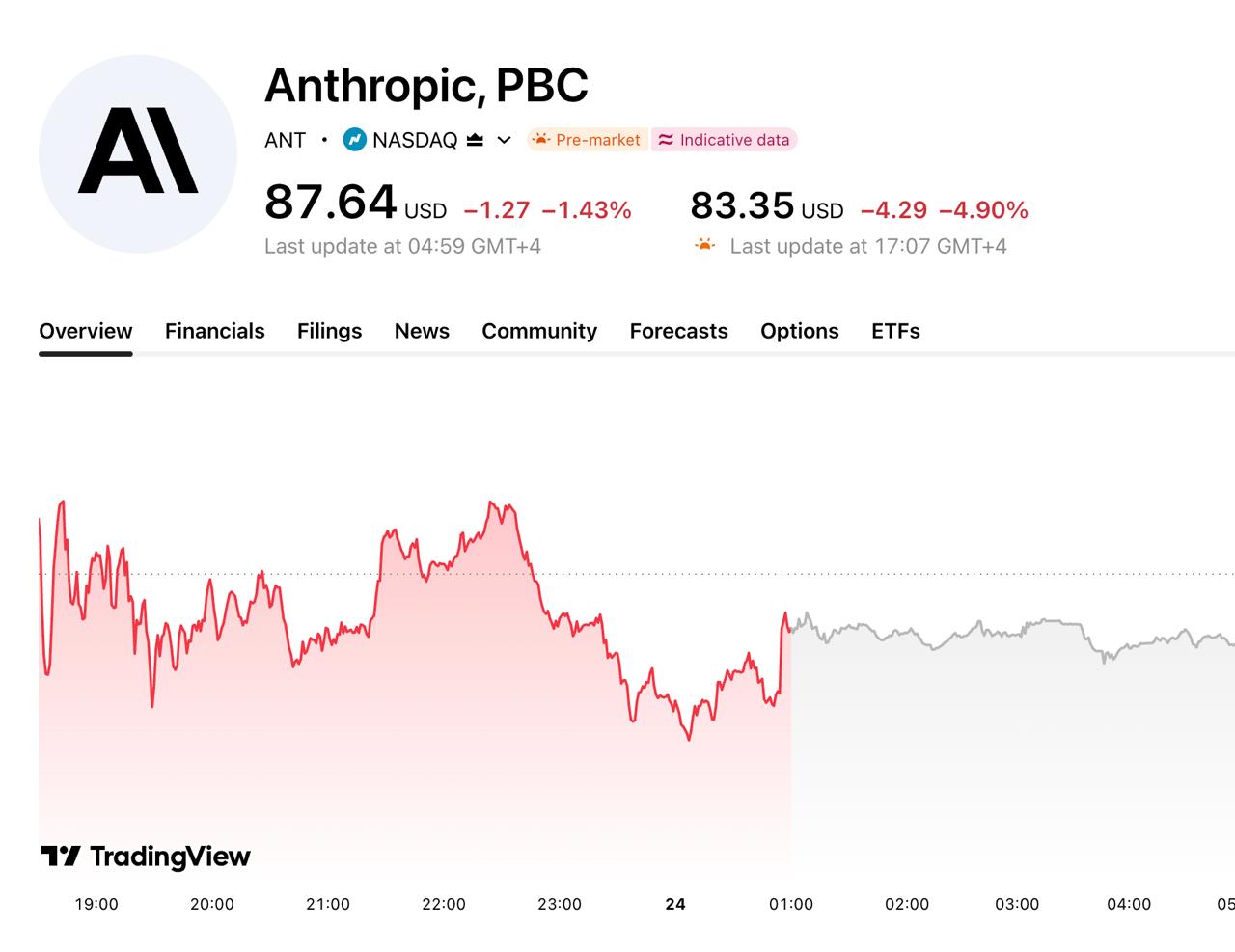
Anthropic’s IPO price break is attributed primarily to the exhaustion of banking-syndicate stabilization support, combined with anticipated share supply and broader technology-market weakness, rather than deteriorating operating fundamentals. The company raised $93.5 billion, priced shares at $83, and initially traded as high as $111.50 before falling to $76.03 on November 24, 2026. Morgan Stanley exercised the entire 147 million-share greenshoe on November 20, eliminating the syndicate’s remaining price-support mechanism.
The factual chronology includes: IPO pricing at 83 on 18 November 2026, above the 70–78 range, raising 68.5 Md in the public offer and 26 Md in private placement (total 94.5 Md$); trading began on the Nasdaq (ticker ANT) on 19 November, opening at 111.50; on 20 November the syndicate exercised the entire greenshoe (147 M shares), bringing total raised to 93.5 Md, with the stock closing at 88.30; on 23 November, CEO Dario Amodei sold 3.37 M shares for over 280 M$; on 24 November the IPO price broke, falling to 76.03. The 15 December 2026 lock-up expiration makes up to 303 million shares (174 M Class A + 129 M Class N) eligible for sale, potentially tripling the current float (7.4% of shares were immediately tradable post-IPO, about 980 M shares).
The greenshoe mechanism is a standard overallotment option where the underwriting syndicate shorts 15% of offered shares before trading. For Anthropic, the syndicate sold 1.127 billion shares versus the base issuance of 980 million, creating a short position of 147 million shares. Two outcomes are possible to cover this position: buy on the secondary market if the price falls below the offer price, or exercise the greenshoe if the price stays above 83. On 20 November, ANT traded around 85–88, so Morgan Stanley exercised the entire greenshoe, closing its short position by issuing new shares and leaving the syndicate with no economic interest in defending the 83 threshold. The breakdown on 24 November is explained by the conjunction of support eliminated, anticipation of the 15 December lock-up, and contracting demand from cross-selling related to the Nvidia scandal and Nasdaq correction. The initial float of 980 M shares represents 7.4% of the 13.2 Md shares outstanding. With 303 M shares released on 15 December, the float increases by 30.9% in a single session, implying a mechanical selling pressure of 5 to 15% depending on demand elasticity.
Fundamentally, Anthropic’s revenue trajectory shows sequential deceleration: QoQ growth fell from 132% in Q1 to 144% in Q2, then to 47% in Q3, with the absolute quarterly increment decreasing for the first time from 6.8 Md in Q2 to 5.4 Md in Q3. The company has engaged 901 Md in computing and infrastructure expenses through 2045, of which approximately 71 Md mature in the year ending 30 September 2027. The cost-of-computation to quarterly revenue ratio rose from 48% in Q2 to 58% in Q3, with an expenditure of 9.9 Md for 17 Md in revenue. The break-even revenue requirement is approximately 169 Md$, more than double the current run-rate. Valuation multiples range from 42x trailing twelve months revenue to 11x sell-side 2027 estimates, reflecting a fundamental divergence on the relevant time horizon. Buyers at 83 paid 42x trailing revenues, while sellers at 76 value the stock at about 10x 2027 revenues; the IPO price breakdown is a partial resolution of this divergence in favor of sellers, but 76 $ is not necessarily a floor.
Seven technology companies—including Google, Microsoft, Nvidia, AMD, and Broadcom—subscribed 26 Md$ of Class N shares at the IPO price, with 10 Md for Nvidia and 1 Md$ for Microsoft. These same companies are suppliers, customers, and shareholders of Anthropic, creating circular dependence: Anthropic’s ability to finance computing purchases depends on its suppliers’ willingness to invest in its capital, while Nvidia’s revenue depends on Anthropic’s ability to buy chips. The contraction of ANT’s price to 76 reduces the value of Nvidia’s participation (10 Md invested, current value approximately 9.16 Md$), potentially affecting Nvidia’s tolerance for continuing to finance the ecosystem. The total shares outstanding are 13.2 Md, with only 980 M (7.4%) currently tradable. The lock-up release calendar shows 303 M on 15 December 2026, another 303 M on 5 January 2027, 353 M on 19 January 2027, 353 M on 2 February 2027, and 1.7 Md post-FY2026 results. By February 2027, the float could more than double, reaching 1.6 Md eligible shares, far exceeding index fund absorption capacity even with MSCI inclusion from 30 November 2026. Modeling the float flood with an estimated index demand of about 100 M shares and price elasticity between 0.5 and 1.5, the net shock is a price pressure of -10.4% to -20.7%, making a return to 65–75 $ mechanically plausible if index demand does not offset the lock-up releases.
The Bank for International Settlements (BIS) in its 2026 Annual Economic Report explicitly identified the AI investment boom as a risk to financial stability, warning that opaque “circular financing” structures and spending commitments exceeding 1,000 Md could amplify any future shock, estimating the five largest hyperscalers will invest more than 1000 Md in AI-related capex in 2025–2026 alone. Anthropic’s IPO price breakdown is the first market test of this thesis. If ANT’s valuation continues to contract, financing conditions for neoclouds and AI labs will tighten, triggering a vicious circle where lower valuations reduce investment capacity, which reduces suppliers’ revenues, which reduces valuations, etc.. Anthropic’s supply contracts with Google (minimum 114.5 Md through 2033) and Amazon (minimum 110 Md through 2036) are cross-defaulted to its credit agreements. A credit rating downgrade (currently unrated but implicitly investment grade due to hyperscaler participation) would trigger cross-default clauses, forcing the company to provide additional guarantees or renegotiate contracts—exactly the type of contagion the BIS described in its stress scenario. The ANT breakdown occurred in a broader correction: the Nasdaq 100 lost 5.6% on 20 November, the S&P 500 3.7%, and the VIX exceeded 29; Nvidia recorded its worst weekly performance since 2008, falling 22.92%. The correlation between ANT and the tech sector is high, meaning ANT’s idiosyncratic risk is amplified by systemic risk.
Game theory analysis shows the syndicate faced a binary choice on 20 November: not exercise the greenshoe, maintain the short position and continue supporting the price (cost: forgoing 12.2 Md$ in potential commissions), or exercise immediately, collect shares at 83 $ and withdraw (cost: loss of support, risk of price breakdown). The syndicate chose the latter, which was rational because buying on the market was more expensive than exercising at 83, but it created a negative externality for IPO investors who lost the safety net. Lock-up holders face a prisoner’s dilemma on 15 December: sell immediately to capture the current price but contribute to downward pressure, or wait and risk further decline if others sell. The Nash equilibrium is to sell, predicting concentrated selling pressure in the first days after 15 December. Institutional flows include up to 19 Md$ of passive buying from MSCI index inclusion on 30 November 2026; strategic investors purchased 26 Md$ at the IPO price with a strategic, not tactical, horizon; retail demand was 100 Md$ during the roadshow, but a significant portion was likely allocated to the gray market and resold after opening. The implied Sharpe ratio, using estimated volatility of 60-80% annualized and expected return of 10-15%, is approximately 0.11, extremely low and reflecting high idiosyncratic risk and liquidity premium.
In conclusion, the IPO price breakdown is a microstructure event triggered by greenshoe exercise, amplified by lock-up release anticipation and sector correction. It does not challenge the long-term fundamental thesis (revenue growth, high gross margins) but reveals a supply asymmetry weighing on the stock in the short and medium term. Recommendations are: short term (0-30 days), do not buy at the current price (76-83 $); wait until 15 December and the digestion of the first lock-up release, with mechanical selling pressure of 30% of the float. Medium term (1-6 months), monitor the 65-70 $ level as a potential entry zone if fundamentals (Q4 2026 revenues, margins) remain solid, as the 11x multiple on 2027 revenues offers a margin of safety. Long term (1-3 years), the bullish thesis is conditional: if Anthropic reaches 170 Md$ of annualized revenues by 2028 and maintains gross margins above 50%, current valuation is attractive; the enterprise AI market is in structural growth. Risk management: set a conviction stop-loss if the guarantee coverage ratio (guarantees/equity) exceeds 50% or if DSO exceeds 70 days, as these signal deterioration in earnings quality.
