Estimated losses in the oil market reached 800 million barrels in March-April, growing to 1 billion barrels by mid-May, according to the IEA. This compares to a cumulative intervention of 400 million barrels, including the US. Before the conflict, global observable reserves in February stood at 8,185 million barrels; however, a significant portion is operational,…
The convergence of physical, behavioral, and microstructural signals confirms that Europe, and particularly France, has entered a regime of asynchronous systemic energy shortage. The three pillars of the breakdown:
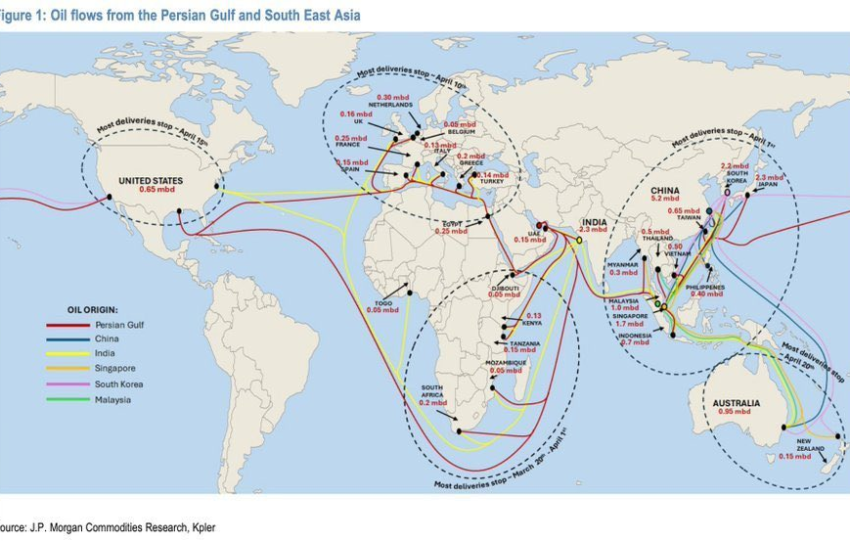
(a) Physical Pillar. The Strait of Hormuz has been practically blocked since February 28, 2026: more than 20% of global oil traffic and 25% of…
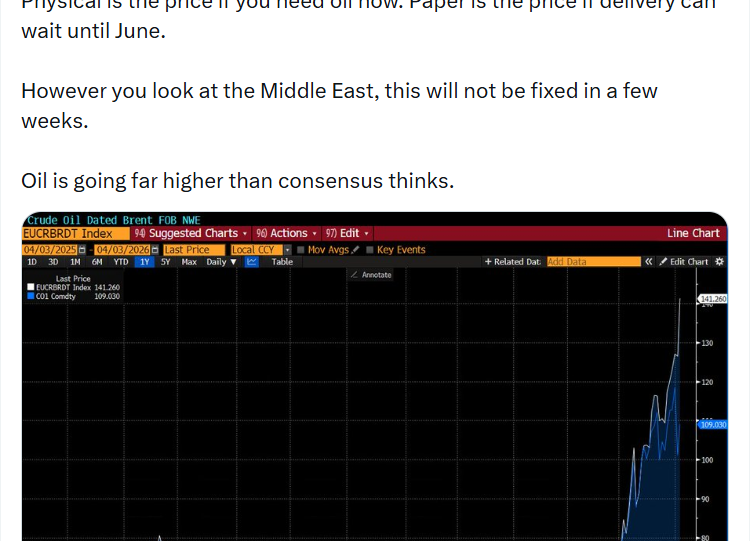
The Brent oil market shows an extreme divergence between the paper price (futures contracts) at $109 and the physical price (spot) at $141, a $32 gap reflecting a strong "backwardation." Normally, future prices are higher than spot prices (contango) due to storage costs; this inversion signals an immediate scarcity of physical oil. The $141 price…
Multi-engine analysis suggests that the closure of the Strait of Hormuz, leading to a supply shock of 20 Mb/d (20% of world consumption), has established a regime of "structural energy constraint." This regime is characterized by a high conditional probability of activating restrictive measures on mobility ("energy lockdown"), estimated at 81.3% for 03/31/26, according to…
Analyse de marché