Nvidia's CFO provided an explicit upper bound. During the Q3 earnings call, Colette Kress stated that AI labs receiving financial support from Nvidia (equity investments, guarantees, credit support) are expected to represent approximately one quarter of the company's business next year. This is the only official quantification of the "supported" portion of demand. It includes…

In his financial architecture Nvidia is no longer simply a semiconductor seller, but a systemic financial intermediary, acting as a venture investor, implicit lender via trade credit, revenue guarantor, and residual value insurer for its ecosystem. This transformation from a linear supply chain to a closed-loop supplier financing circuit is verifiable in the financial statements…
Analysis of Nvidia's financial architecture as an AI mega-bank
Our article describes how Nvidia has built a financial architecture of an "AI mega-bank" by acting as a capital investor, implicit lender, revenue guarantor, and residual value insurer for its ecosystem, circumventing accounting barriers (ASC 326 and ASC 606 standards) via a two-tier structure combining on-balance-sheet…
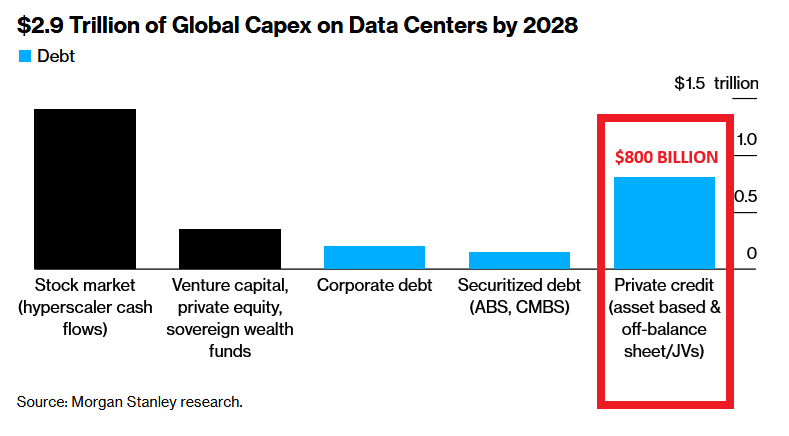
Private credit funds face significant 2026 risks from two AI-related channels: disruption to software borrowers and demand shortfalls in AI infrastructure. These are compounded by liquidity mismatches, sector concentration, and ties to insurers and pensions. Non-bank direct lending, via vehicles like BDCs, has heavily expanded into both areas, heightening vulnerability.
Two Primary AI-Related Risk…
Intel 18A is not a new x86 processor architecture, but rather a 2nm-class manufacturing process node where Intel will fabricate future CPUs, SoCs, and potentially chips for external clients. This process technology is highly anticipated, as it is central to Intel's strategy to overcome nearly five years of problems, aiming to mark a significant "before…
Intel experienced a massive surge in market capitalization, growing 3.2 times (221%) between March 30 and May 8, 2026, representing one of the strongest percentage gains for any company valued over $200 billion in a 28-day period.
Over the past year, since its lows in April 2025, the company's valuation has increased 7.5 times.…
L'année 2025 marque une accélération de la convergence des mégaforces, générant des opportunités et des risques non-linéaires. L'Intelligence Artificielle (IA) devient contrainte par son infrastructure matérielle et énergétique. Cela dicte trois axes d'investissement cruciaux : (i) l'extension de la chaîne de valeur de l'IA en amont vers les besoins en commodités numériques (tokens de calcul)…
Analyse techniquement irréprochable de la stratégie fiscale la plus avancée dans l'ère post-BEPS (Base Erosion and Profit Shifting)
Ce schéma n'est pas une simple "optimisation", mais une réingénierie structurelle de la chaîne de valeur pour aligner le (i) lieu de la création de richesse fiscale sur le (ii) lieu de la substance économique réelle (Compute).…
RÉSUMÉ
Alphabet, Amazon, Meta, Microsoft et Oracle ont émis un total de 88 milliards de dollars en obligations de qualité investissement entre septembre et novembre 2025, selon Dealogic. Ce montant, qui dépasse largement les émissions des trois années précédentes (66 milliards de dollars), est principalement motivé par des investissements massifs dans l'infrastructure de l'IA, notamment…
Le secteur de l'IA et des infrastructures critiques observe une montée en puissance du financement via des véhicules spéciaux (SPV) et du shadow banking technologique, une tendance adoptée par les géants de la technologie (Big Tech, Semi, Cloud). Ces schémas, illustrés par NVIDIA/xAI, visent à accélérer la (i) reconnaissance des revenus, (ii) externaliser l'endettement (hors…
Analyse de marché