(1) XRP — Settlement Layer and Liquidity Bridge
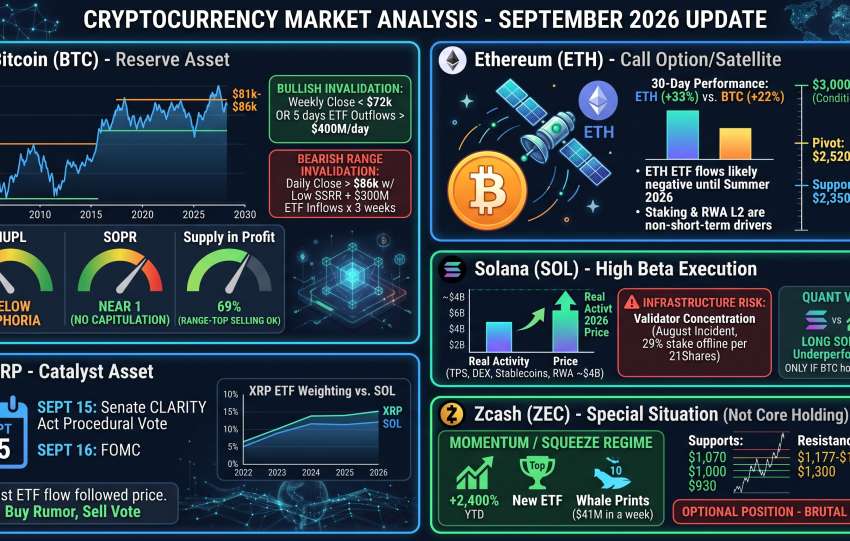
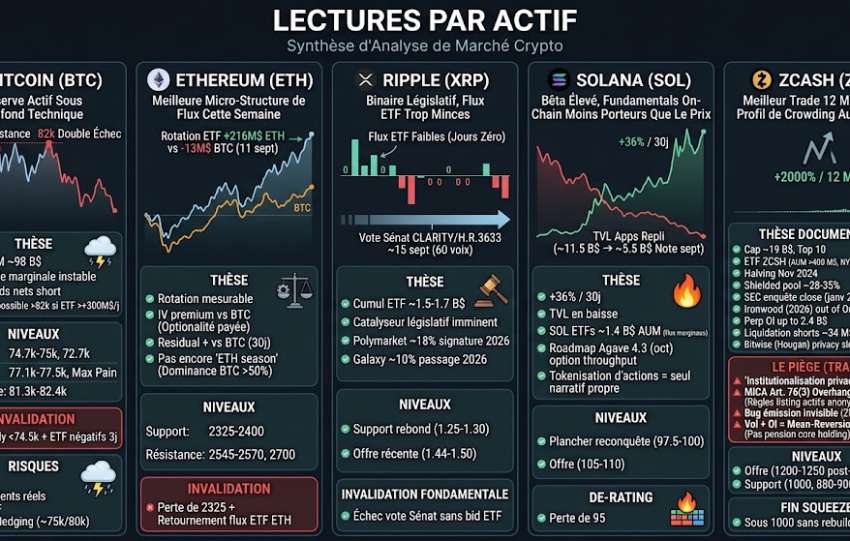
XRP serves as a neutral liquidity bridge between different fiat currencies and tokenized assets. The arrival of seven US spot XRP ETFs (approximately $1 billion in AUM) signals progressive institutionalization. Demand for XRP structurally stems from the volume of transactional flows, which creates continuous buying pressure…
Cryptos
Toute l'actualité du monde des cryptos en France et (plateformes, cryptos, rachat, IA, acteurs, fondateurs). Vidéos, analyses, commentaires et interviews.
The gradual shift of the XRP Ledger (XRPL) from a simple payment network to a true institutional settlement layer (RWA, tokenization, interbank cross-border settlements) is empirically observable.
J.P Morgan recently revealed its utilization of the XRPL.✅ Up next? 🙇♂️ Goldman Sachs and Citi.😏💨 https://t.co/nCu062uXxz — SMQKE (@SMQKEDQG) May 9, 2026
Quantitative Validation Elements …
Central Thesis: The integration of Coinglass Liquidation Map data, the 3D rising wedge pattern, and BTC/Stablecoins dominance reveals that BTC has climbed towards 81,800 USD based on 17.68 billion in vulnerable long leveraged positions below current levels. This configuration, superimposed on the geometry of the 3D rising wedge (mechanical target 67,500-70,000 USD in case of…
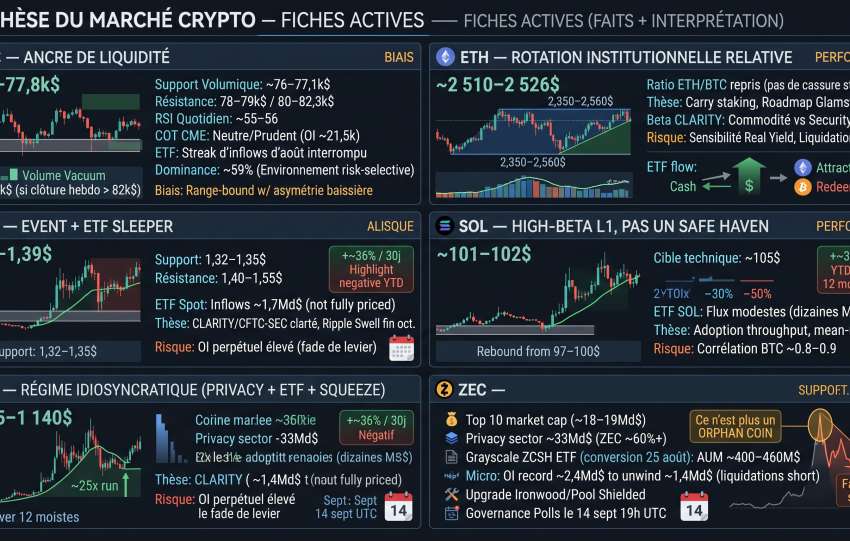
The Glassnode "Expansion, Breakdown, Stabilization" framework identifies a mature stabilization phase with volatility-adjusted support built around ~$74,000 and confluent resistance at $80,000–$83,000. This $78K–$83K zone constitutes the "Breakeven Battlefield" where the following overlap: (i) the STH Cost Basis at $78,700 (v5.0), (ii) the True Market Mean Price at ~$81,500 (v3.0), and (iii) the ETF Cost…
Visual Data
Red arrow: resistance cluster at $78,000–$80,000 (confluence of Realized Price, True Market Mean Price, Active Realized Price, Investor Price, STH Realized Price).
Green arrow: structural support cluster at $45,000–$50,000 (LTH Realized Price, CVDD, Delta Price, Average Price). The current price is positioned at the level of the red arrow, testing the…
The STH Cost Basis (STHCB), a key indicator for Short-Term Holders, has sharply declined from over $100,000 in January 2026 to approximately $78,700 in May 2026. The current spot price trades below this STHCB, which recently rejected an upward test. This decline signals ongoing capitulation among recent buyers, as "weak hands" sell into dips, resetting…
The distinction between a "trap" and a "trigger" in market analysis centers on their nature, observability, agents involved, and timing.
A trap is a static liquidity configuration, often visible in liquidity heatmaps as bid clusters (e.g., 76K–80K), indicating passive retail accumulation and suggesting resistance (high Kyle's Lambda). This configuration can take hours or days…
Cohort-Normalized CVD (Cumulative Volume Delta): Colored lines reveal that small orders ($100–$10K, green/orange lines) are buying on upward moves, while large blocks ($1M+, purple lines) are selling. Correlation with our April 27th statements : The April 27th post hypothesized a "stealth institutional distribution" in the $77,000–$80,000 range, with a negative delta of –699.51 and a…
Visual Data: Liquidation density concentrated at $75,000 (long cluster) and $80,000–$85,000 (short clusters). 1-week heatmap showing yellow/orange bands (high density) at 75K and 81K+. Current price in a "blue" area (low density), i.e., compression zone.
Correlation with the April 30th study:
The April 30th study modeled a bimodal distribution of liquidations:
Mode…
Visual Data:
¤ Clear resistance zone between $77,400 and $78,000 USD.
¤ Fibonacci 65% at $77,411 USD, 61.8% at $77,196 USD.
¤ Current price below resistance.
Correlation with the April 27th Study: The April 27th study identified the selling wall at $79,000–$80,000…