Carbon Credit Market

The Core Carbon Principles (CCP), established by the Integrity Council for the Voluntary Carbon Market (ICVCM), constitute the most stringent quality benchmark in the carbon market. CCP-qualified credits must satisfy three fundamental criteria: additionality (the emission reductions would not have occurred without the financial incentive of the carbon credit), permanence (the reductions are irreversible over climatically relevant timescales), and no leakage (emissions are not displaced to other sectors or geographical regions).
Quantitative analysis of quality spreads reveals an average CCP premium of 46% compared to non-certified credits, with this premium acting as a fiscal buffer by partially absorbing the impact of the QDMTT top-up tax on net returns.
This quality premium functions as an endogenous resilience mechanism in the post-Pillar Two environment: high-integrity credits, which are more easily traceable and verifiable, reduce accounting uncertainty and thus the risk of ETR adjustment by tax authorities. Conversely, questionable quality credits, subject to media controversy and regulatory investigation, generate a risk of provision for tax litigation that erodes the ETR numerator.
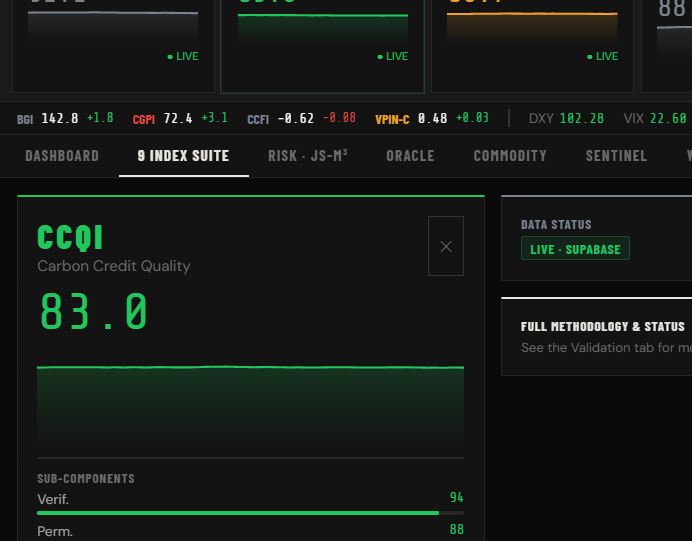
The STEELLDY CCQI incorporates this quality dimension by weighting sectoral components according to their adherence to CCP principles and additional blockchain traceability criteria. The empirical correlation between the CCQI and the ICE EUA index of 0.78 suggests that the CCQI captures both regulated carbon market risk and a quality premium component specific to tokenized VCM. This duality makes the CCQI a potential hedging instrument against basis risk between compliance and voluntary markets, but also a sensor sensitive to systemic fiscal shocks like Pillar Two.