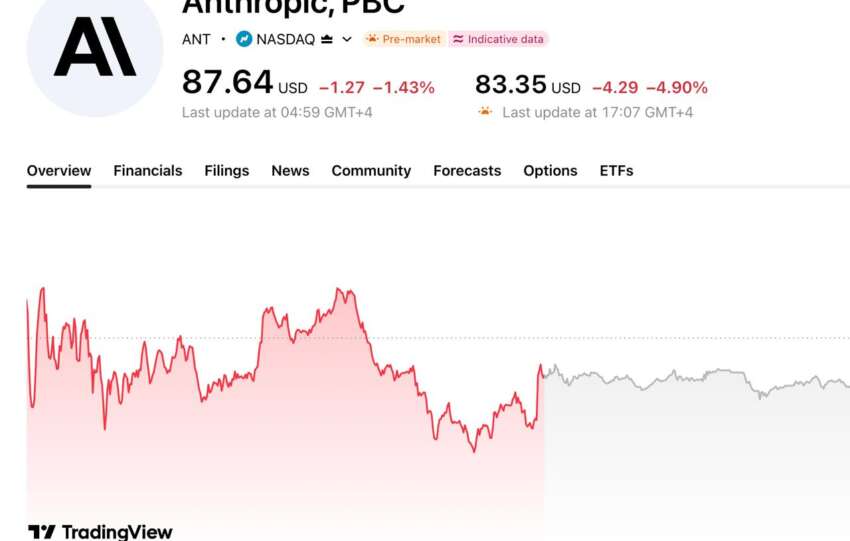
Anthropic PBC completed the largest IPO in history, raising 93.5 billion dollars via 1.127 billion actions at 83, with a fully diluted capitalization of approximately 1,500 Md. The stock opened at 111.50, a 34% premium over the offer price, before closing at 97.17 on the first day. On 24 November 2026, the fourth trading day,…
Nvidia's CFO provided an explicit upper bound. During the Q3 earnings call, Colette Kress stated that AI labs receiving financial support from Nvidia (equity investments, guarantees, credit support) are expected to represent approximately one quarter of the company's business next year. This is the only official quantification of the "supported" portion of demand. It includes…
At this stage, Nvidia is not a "second Enron" in the sense of proven accounting fraud. Operational cash flows remain massive ($122.7 billion over nine months in FY2027) and the gross margin of 74.8% precludes any talk of "phantom sales."
However, the revenue generation structure has shifted toward a very large-scale vendor financing model, which…
In his financial architecture Nvidia is no longer simply a semiconductor seller, but a systemic financial intermediary, acting as a venture investor, implicit lender via trade credit, revenue guarantor, and residual value insurer for its ecosystem. This transformation from a linear supply chain to a closed-loop supplier financing circuit is verifiable in the financial statements…
Analysis of Nvidia's financial architecture as an AI mega-bank
Our article describes how Nvidia has built a financial architecture of an "AI mega-bank" by acting as a capital investor, implicit lender, revenue guarantor, and residual value insurer for its ecosystem, circumventing accounting barriers (ASC 326 and ASC 606 standards) via a two-tier structure combining on-balance-sheet…
The circular financing thesis analyzes the balance sheet structure of Nvidia, whose market capitalization is approaching $4 trillion, highlighting that its off-balance-sheet commitments have reached $530 billion (fiscal Q2 2027 figure, ended July 26, 2026), compared with $184 billion one quarter earlier. Publicly available data as of mid-November 2026 validate most of the factual claims…
Quantitative modeling assesses AI infrastructure risks through several methods. A Monte Carlo simulation of 100,000 trajectories over 24 months, using expansion and disillusionment drifts of 15% and −25%, volatilities of 20% and 45%, a monthly jump probability of 3%, and normally distributed jumps with mean −35% and standard deviation 10%, yields cumulative losses at the…
The restructuring of the global economy to finance the AI capital shortfall rests on recycling Asian savings, mobilizing new investors, and transforming cash flows into investable assets.
First, the AI boom generates liquidity in South Korea and Taiwan, part of which flows into dollar-denominated assets and indirectly supports investment by US hyperscalers. Taiwan’s current…
AI capex has become an infrastructure cycle of utility-like scale , comparable to railroads or the electrical grid , with a readable value chain: semiconductors (the cluster of megacaps that the market now groups under acronyms like "MANBRIC": Microsoft, Apple, Nvidia, Broadcom, and others), data centers, energy, and now physical robotics. Biotech remains the pocket…
EXECUTIVE SUMMARY. QUANTITATIVE FINANCE
Contagion in AI financing cannot be understood through valuation levels or even growth rates. It is grasped through the counterparty dependency structure and the second derivative of infrastructure spending.
Our cross-analysis shows:
¤ The central risk is not the disappearance of AI demand, but the existence of a…
Analyse de marché