Skip to content Skip to sidebar Skip to footer

Site icon Economie

Category image

Economie

Toute l'actualité économique et financière en France et dans le monde. Vidéos, analyses, interviews.

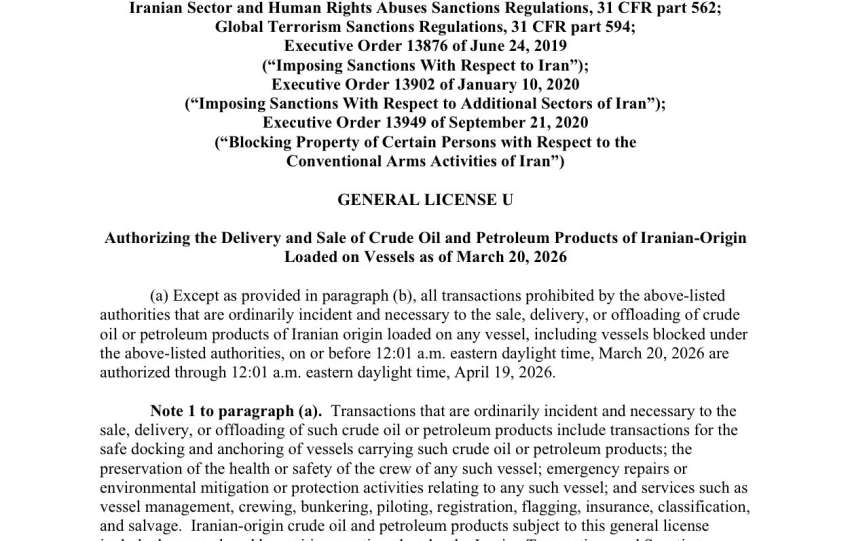
The U.S. Treasury temporarily lifts nearly all sanctions on Iranian oil tankers, allowing exports loaded March 20 – April 19, 2026, signaling a major shift in Iran policy

The U.S. Treasury's General License U (issued March 20, 2026) is explicitly designed to exert downward pressure on oil prices by flooding the market with additional supply at a time when prices have surged over 50% since the U.S.-Israeli conflict with Iran began in late February. Why It Targets Prices The license authorizes the…
Read more

On-chain and behavioral analysis focuses on investor cohorts, modeled by Gaussian Mixture Models, and key indicators

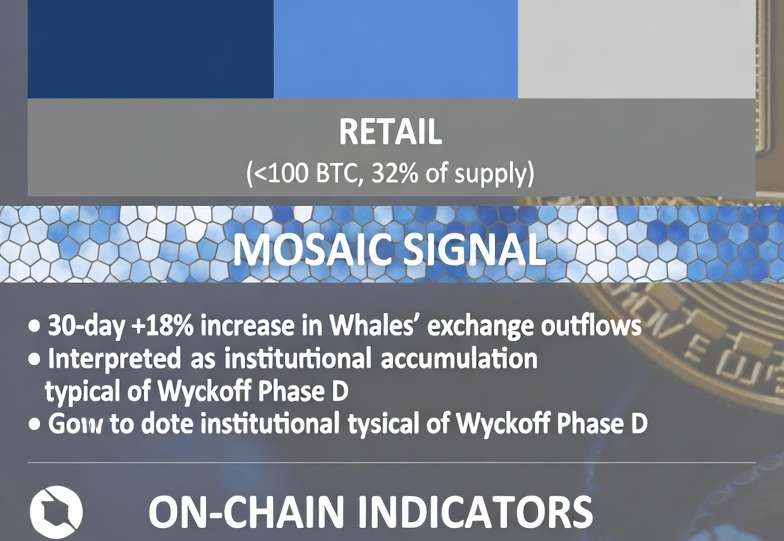
On-chain and behavioral analysis focuses on investor cohorts, modeled by Gaussian Mixture Models, and key indicators. Mega Whales (>10k BTC, 28% of supply) show silent accumulation, signaling a neutral to bullish trend. Whales (1k-10k BTC, 22% of supply) are actively increasing their exchange outflows, indicating active accumulation. Sharks (100-1k BTC, 18% of supply) are in…

Read more

The Three-Dimensional Dynamics of Gold/Wheat/Bitcoin (XAU/ZW/BTC) – The Survival Triangle in a Systemic Crisis Regime

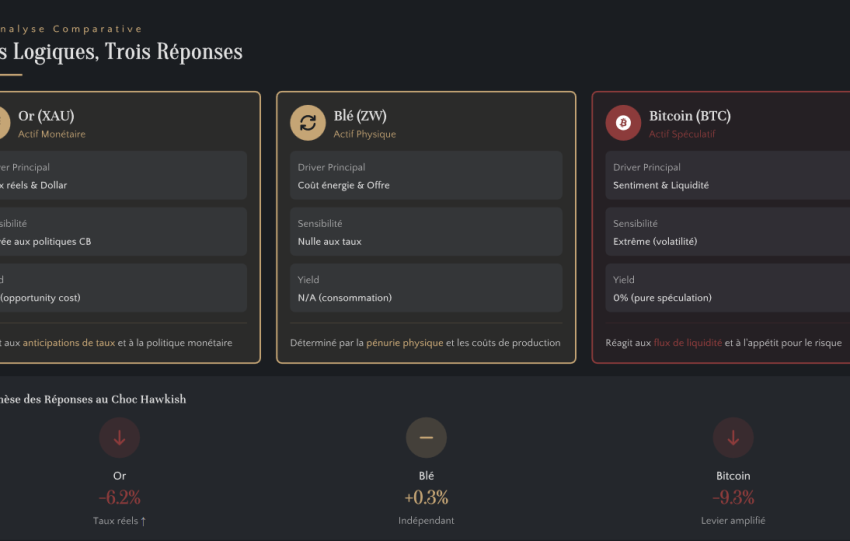
The Trinity of Survival Recomposes Itself The March 19, 2026 session marked a structural recomposition of the assets we previously labeled the "Doomsday Corner." Steelldy's multi-engine integration reveals a tri-variate correlation matrix undergoing a regime shift. Gold (XAU): Experienced a violent correction (-6.2%, to $4,575 USD) under the "dictatorship of real rates" after the Fed's…

Read more

Tactical Decoupling Gold/Wheat – Analysis of the Fall of Gold to $4,575

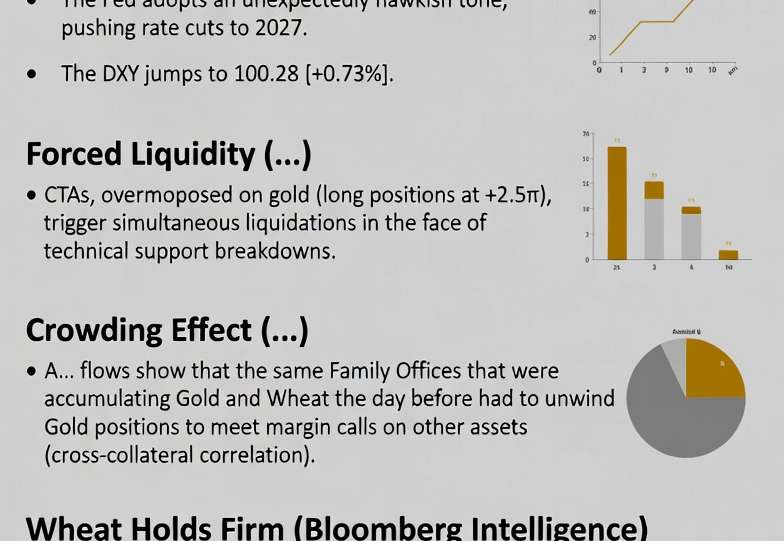
The drop in gold to $4,575 (the sharpest daily decline since 2020) does not invalidate the "Gold/Wheat = Twin Survival Assets" thesis. It represents a tactical decoupling induced by a sudden shift in monetary regime. Multi-engine analysis reveals the following sequence: Monetary Shock: The Fed adopts an unexpectedly hawkish tone, pushing rate cuts to 2027.…

Read more

The emergence of a Gas-Wheat correlation of 0.75 indicates a transmission of energy shocks to agriculture not modeled by traditional approaches

This study presents a multi-layer quantitative intelligence architecture for modeling extreme geopolitical risk, applied to the current Persian Gulf crisis. We formalize the integration of our proprietary risk engines with alternative data (Alt-Data) methodologies and advanced behavioral frameworks. The main academic contribution is the development of the SVCJ-GARCH-Strait model (Stochastic Volatility with Correlated Jumps–Generalized Autoregressive…

Read more

Debt, Deficits, and Dollar Debasement Fueling Gold’s Bull Market

In a podcast discussion, Mike Maharrey of Money Metals interviewed Brian Lundin, President and CEO of Jefferson Financial, regarding factors influencing the gold and silver markets. Lundin argued that long-term monetary trends, rather than short-term geopolitical events, fundamentally drive metal prices. While global conflicts like tensions involving Iran caused brief spikes in gold prices…

Read more

Capital Flight from the Emirates to Stablecoins – The « Digital Safe Haven » Phenomenon in the Context of Geopolitical Crisis

The integrated analysis of the Steelldy Risk Engine and Steelldy Gotham confirms that the USDC stablecoin has become the preferred vehicle for massive capital flight from the United Arab Emirates (UAE) due to three critical factors: the real estate collapse (a 31% drop), operational failures of local banks, and the regulatory superiority of USDC over…

Read more

Private Credit Risk Assessment and Liquidity Contagion Dynamics

Morgan Stanley (MS) is experiencing a severe liquidity crisis in its Direct Lending segment. This pressure stems from three systemic factors: (i) massive redemptions by Business Development Companies (BDCs), (ii) rapid devaluation of underlying tech assets (notably due to AI disruption), and (iii) margin compression from falling benchmark rates. We anticipate a “Capital Exodus” similar…

Read more